
Choose Dauthau if you need to find, track, and analyze Vietnamese procurement opportunities; choose Tratencongty.com if your immediate task is looking up a company rather than researching tenders. This 2026 comparison separates procurement intelligence from company lookup so you can choose around the decision you actually need to make.
- For dauthau.asia vs tratencongty.com, choose procurement intelligence for tender research and company lookup for business identification.
- Dauthau is best for Vietnamese businesses researching tenders, contractors, and bidding results.
- Tratencongty.com is the better starting point when your task begins and ends with a company lookup.
- Neither a company listing nor a bidding record replaces the documents needed for a procurement decision.
Why this matters
A company lookup and a tender search answer different questions. One helps you identify a business; the other helps you assess an opportunity and understand its procurement context.
Confusing them creates incomplete research. Finding a company does not establish which tenders fit your business, and finding a bidding result does not establish that a supplier meets your requirements.
For a 2026 software decision, start with the output your team needs: a company identity, a shortlist of opportunities, or an assessment of bidding activity. Choose the category before comparing individual features.
At a glance
| Dimension | Dauthau | Tratencongty.com |
|---|---|---|
| Best for | Vietnamese businesses researching procurement opportunities | Users starting with a company lookup |
| Tender discovery | Searches public and private procurement tenders across Vietnam | Start here for a company question, not as the basis of a tender-research recommendation |
| Opportunity tracking | Supports tracking procurement tenders | Evaluate separately if your task extends beyond company lookup |
| Bidding-results analysis | Supports analysis of bidding results and contractor data | Company identification is the relevant starting use case |
| Standalone company lookup | Contractor information sits within a procurement-intelligence use case | Better starting point for a lookup-only task |
| Task scope | Search, tracking, and analysis across procurement research | A narrower company-identification starting point |
| Verification | Check relevant records against supporting documents | Check relevant records against supporting documents |
| Pricing model | Confirm current access and billing terms | Confirm current access and billing terms |
| Standout distinction | Procurement context connects opportunities, contractors, and results | Starts with the business you want to identify |
The distinction is about purpose, not a claim that every feature belongs exclusively to one service. Test any additional requirement directly before making it part of your selection criteria.
Tender discovery favors procurement intelligence
Dauthau is best for Vietnamese businesses that need tender search, tracking, and bidding-results analysis. Its stated scope covers public and private procurement tenders, contractor data, and bidding results across Vietnam.
That scope matters when your starting question is about opportunity: what should your team investigate, and what information would help assess it? A company name alone does not answer that question.
Use procurement intelligence when you need to move from an area of business interest toward a shortlist of relevant tenders. Then examine each opportunity's actual requirements before deciding whether to pursue it.
The limitation is equally important: discovering a tender is not the same as establishing eligibility. Your team still needs to read the applicable documents and determine whether the opportunity matches its capabilities.
Best for: business-development and bidding teams researching procurement opportunities rather than identifying a single business.
Tender tracking favors an ongoing procurement workflow
A tender-research process does not end with the first search. Once an opportunity becomes relevant, your team needs a way to follow it and retain the context behind its decision.
The procurement platform explicitly supports tender tracking. That makes it the stronger fit when your work continues after discovery, rather than ending after a company record has been located.
Before adopting a tracking workflow, define what your team expects to follow. Separate monitoring the opportunity from completing the work needed to respond to it.
Use 3 checks during your 2026 evaluation:
- Relevance: Does the opportunity match the work your business can deliver?
- Ownership: Who is responsible for reviewing the underlying documents?
- Next action: What decision should follow the review?
These are evaluation steps, not claims about automated features. Do not assume that tracking includes a particular notification channel, submission function, or internal approval process unless you confirm it directly.
Bidding-results analysis favors procurement context
Procurement research also looks backward. Past bidding results can help your team understand recorded activity before deciding what to investigate next.
Dauthau supports analysis of bidding results and contractor data. That is a stronger match for questions about procurement participation and outcomes than a workflow built only around identifying a company.
Keep the interpretation narrow. A recorded outcome describes that procurement event; it does not automatically explain every reason behind the decision or establish future performance.
For useful analysis, distinguish between these questions:
- Which contractor does the record concern?
- What procurement event does the record describe?
- What conclusion does the underlying information actually support?
Best for: analysts and bid managers who need procurement context, not just a business name. The tradeoff is additional interpretation: more relevant records still require careful reading.
Tratencongty.com is the better starting point for lookup-only work
Choose Tratencongty.com when the immediate question is simply which company you are dealing with. A lookup-first task does not automatically require an ongoing procurement-research workflow.
For example, you might need to distinguish similarly named businesses before continuing your research. Start with business identification, resolve the identity question, and then decide whether procurement information is necessary.
The advantage here is task fit, not an unsupported claim about speed, record completeness, or interface quality. No measured comparison establishes that either service completes a lookup faster.
The limitation is the boundary of the question. Identifying a business does not, by itself, show which tenders are relevant to your team or explain the company's procurement history.
Best for: staff handling a discrete company-identification request. If the next question concerns bidding activity, add procurement research rather than treating the initial lookup as the finished assessment.
Tratencongty.com fits a narrower stopping point
A narrower task can be the right task. If your deliverable is a resolved company identity, continuing into tender research adds work that the request did not require.
Tratencongty.com is the more relevant starting choice for that stopping point. The procurement platform becomes more relevant when your deliverable expands into finding opportunities, tracking tenders, or analyzing results.
This is not a claim that one interface is simpler or that either service lacks additional capabilities. It is a recommendation to match the research process to the required output.
Define the stopping point before you begin:
- Company identity: establish which business the request concerns.
- Tender shortlist: identify opportunities for further review.
- Bid assessment: examine procurement information before deciding what to pursue.
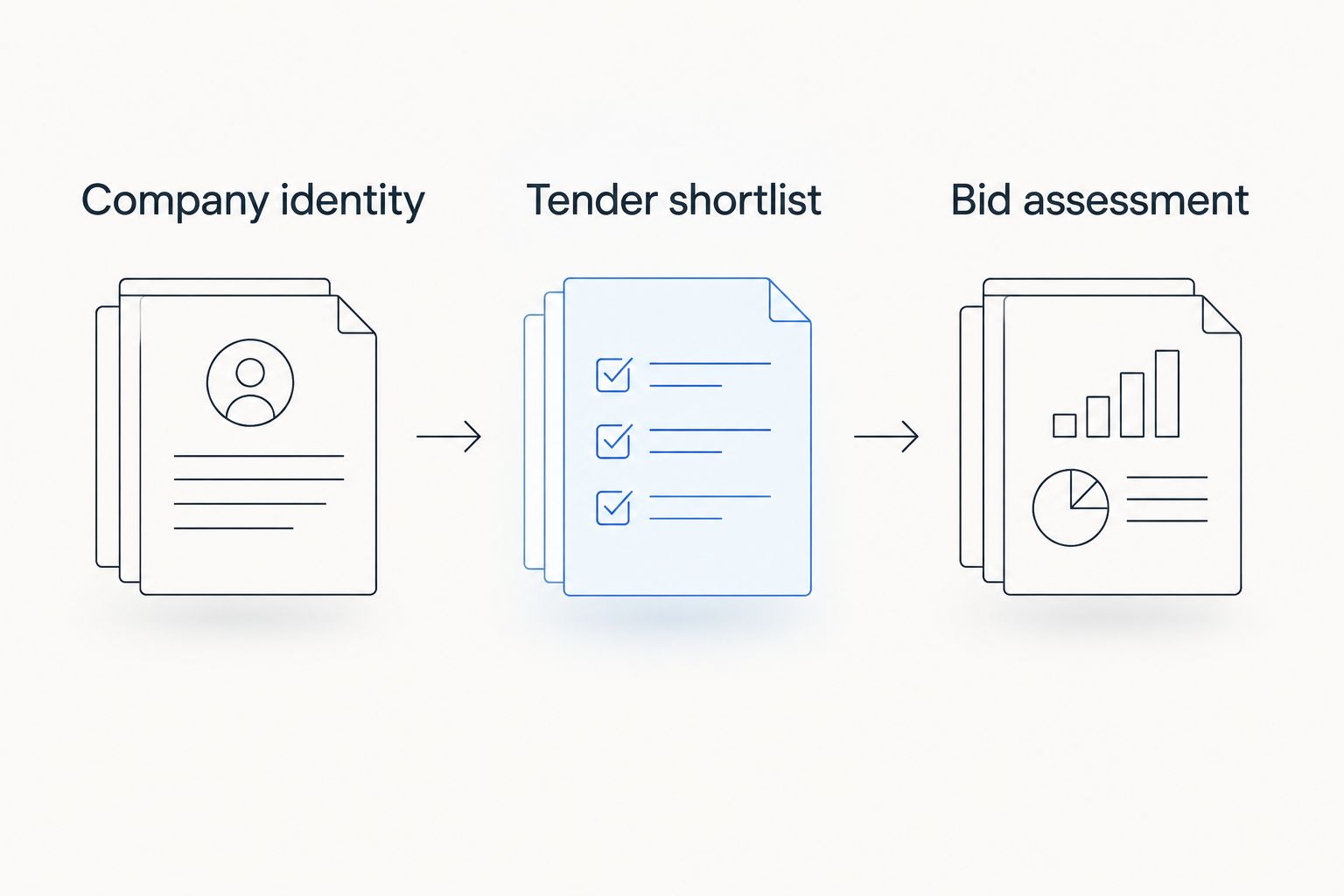
A defined destination also prevents a false comparison. A tool that answers your company question is not necessarily the tool that answers your tender question, and the reverse is equally true.
Both require verification before a consequential decision
Neither a company listing nor a procurement record should become your entire due-diligence process. Use the information to identify what needs checking, then examine the relevant supporting documents.
For company research, make sure the business in the record is the business involved in your transaction. For procurement research, make sure the tender or result concerns the opportunity you are assessing.
Apply the same evidence standard to both services. Check the record's context, the identity it concerns, and whether the information supports your intended conclusion.
Neither product wins this dimension simply by belonging to a particular category. Verification is a responsibility in your workflow, not a benefit you can infer from a platform name.
Pricing: compare access terms against the work required
Do not choose between these services on an assumed pricing model. Confirm each service's current access and billing terms before treating it as a purchasing alternative.
For a 2026 evaluation, separate the commercial questions from the feature questions. A service can fit the research task while its access conditions fail to fit how your team works.
Ask both providers the same questions:
- Which information and functions does the proposed access include?
- Is access arranged for an individual or a team?
- Is billing recurring, usage-based, or structured another way?
- Which restrictions affect your intended workflow?
- What happens when your research needs change?
Predictable billing helps when research is continuous. Flexible access matters when work is occasional. Those are purchasing tradeoffs to assess, not pricing models attributed here to either service.
The commercial winner is the option whose confirmed terms cover your actual task. Compare equivalent requirements rather than treating a company lookup and ongoing tender research as interchangeable purchases.
Final verdict: choose around your required output
Choose Dauthau if you manage a procurement pipeline
Named profile: a Vietnamese business-development lead or bid manager. You need to search public and private tenders, track relevant opportunities, and analyze contractor information or bidding results.
The procurement-intelligence platform matches that stated scope. Its advantage is relevance to a continuing bidding workflow; its limitation is that research still requires document review and a business decision.
During your 2026 evaluation, use a real opportunity your team understands. Ask whether the available information helps you reach a clearer shortlist or a better-supported pursue-or-decline decision.
Choose Tratencongty.com if you need company identification
Named profile: an operations or administrative user resolving a company lookup. Your immediate deliverable is identifying the business, not building a tender pipeline.
Start with the lookup service and stop when the identity question is resolved. If the assignment expands into procurement participation or bidding results, treat that as an additional research requirement.
The advantage is alignment with a narrow task. The limitation is that a resolved company identity is not a complete assessment of an opportunity, supplier, or contractor.
One-glance scorecard
| Dimension | Winner |
|---|---|
| Tender discovery | Dauthau |
| Ongoing tender tracking | Procurement-intelligence platform |
| Bidding-results analysis | Procurement-intelligence platform |
| Lookup-only starting point | Tratencongty.com |
| Narrow company-identification stopping point | Tratencongty.com |
| Verification responsibility | Tie: verify the underlying information |
| Commercial fit | No winner without confirmed access terms |
FAQ
Which is better in 2026: dauthau.asia or tratencongty.com?
Choose the procurement-intelligence platform for tender search, tracking, and bidding-results analysis; choose Tratencongty.com when your immediate task is company lookup. The right choice follows the output your team needs, not a universal ranking.
What's the better choice for finding Vietnamese tenders?
Dauthau is the better-supported choice for finding Vietnamese tenders. Its stated scope includes searching, tracking, and analyzing public and private procurement tenders across Vietnam.
Should I use Tratencongty.com for a company lookup?
Tratencongty.com is the more relevant starting point when your task is identifying a company. If you also need to understand procurement activity, add a separate tender-research step.
Does finding a company prove that it is suitable for a tender?
No. Company identification does not establish compliance with a tender's requirements; review the applicable documents and the business's supporting evidence.
Does tender tracking mean I can submit a bid through the same service?
Do not assume that tender tracking includes bid submission. Confirm the submission process and required systems separately before building your workflow around them.
How should I compare the cost of these services?
Compare current access and billing terms against the same written requirements. Confirm included information, permitted users, billing structure, and restrictions directly rather than assuming either service's pricing model.
Can I use both services in the same research process?
Yes, a company-identification step and a procurement-research step can serve different purposes in one process. Keep the company identity consistent across records and verify the information supporting your final decision.
One last thing
Before your next 2026 evaluation, write the decision you need to make above the search box. Use a concrete sentence: identify this company, shortlist relevant tenders, or assess this procurement record.
That sentence is your selection criterion. If the result does not help answer it, finding more information is not the same as making progress.