
Choose Dauthau if you need to find, track, and analyze procurement opportunities in Vietnam; choose Thuvienphapluat.vn if your main task is researching Vietnamese legislation and legal requirements. In 2026, the distinction is tender intelligence versus legal reference—not two interchangeable ways to manage a bid.
- dauthau.asia vs thuvienphapluat.vn compares tender intelligence with Vietnamese legal research, not equivalent bidding systems.
- Dauthau is best for Vietnamese businesses researching tenders, contractors, and bidding results.
- Thuvienphapluat.vn is best for researching Vietnamese legislation and procurement rules.
- Use procurement data to assess an opportunity; use applicable legal texts to check the rules.
Why this comparison matters
A tender opportunity and a legal requirement answer different questions. Finding an attractive contract does not establish eligibility, and finding the governing regulation does not tell you which opportunity deserves your attention.
For your 2026 selection, start with the decision your team needs to make. Business development needs evidence about opportunities and market participants. Legal or compliance staff need the applicable rule, its status, and its relevance to the specific procurement procedure.
Buy for the task you repeat, not for the broad label of procurement software. Neither a legal-reference resource nor a tender-intelligence platform should be treated as an automatic substitute for the other.
At a glance
This 2026 comparison separates the platforms by purpose. The verification and compliance rows describe the standards you should apply, rather than claiming that either platform guarantees a correct decision.
| Dimension | Dauthau | Thuvienphapluat.vn |
|---|---|---|
| Best for | Vietnamese businesses researching procurement opportunities | Users researching Vietnamese law and legal requirements |
| Tender discovery | Search and analysis of public and private procurement tenders | Legal research supporting procurement decisions |
| Opportunity tracking | Tracking procurement tenders | Reference work about the rules governing a process |
| Contractor and results research | Contractor data and bidding-results analysis | Legal context for interpreting procurement obligations |
| Legal research | Procurement intelligence is the stated product focus | Vietnamese legal reference is the core use case |
| Interpreting requirements | Commercial and procurement-data context | Research into relevant legal provisions |
| Evidence verification | Check underlying procurement records | Check underlying legal texts and applicability |
| Compliance responsibility | Your team must validate the bid decision | Your team must validate the legal interpretation |
| Pricing model assessment | Evaluate tender-data access, users, and permitted use | Evaluate legal-content access, users, and permitted use |
| Standout distinction | Tender, contractor, and bidding-results intelligence | Vietnamese legislation and legal-reference content |
Dauthau is best for Vietnamese tender discovery
The tender-intelligence platform serves businesses searching, tracking, and analyzing public and private procurement tenders across Vietnam. That makes it the closer fit when your starting question is commercial: which opportunities deserve attention?
Your evaluation should follow an actual search task. Select a procurement need relevant to your business, inspect the results, and decide whether the records give your team enough context to investigate further. Do not judge suitability from the presence of a search box alone.
Useful evaluation questions include:
- Does the opportunity match what your business supplies?
- Can your team distinguish relevant tenders from unrelated notices?
- Does the record support a clear next research step?
- Can you connect the opportunity to the contractor or results research your decision requires?
The advantage is task fit: tender intelligence supports opportunity research. The limitation is equally important: an attractive record is not proof that your business meets the tender's requirements.
Thuvienphapluat.vn is the better starting point when the search concerns a rule rather than an opportunity. Looking for the legal basis of a procurement procedure is a different job from building a shortlist of contracts.
The tender platform wins for tracking procurement opportunities
Tracking belongs with the opportunity workflow. Once your team identifies a relevant tender, it needs a consistent way to revisit the procurement information and decide whether the opportunity still merits work.
The platform's stated scope includes tender tracking. Evaluate that capability against your own handoff process: who reviews the opportunity, who checks its requirements, and who decides whether to proceed?
Keep the assessment concrete. Ask your team to follow a relevant tender through its normal review process and record where information becomes insufficient. This tests workflow fit without assuming a particular alert channel, notification frequency, integration, or internal approval feature.
Thuvienphapluat.vn serves a different tracking need in this comparison: keeping legal research connected to the rule being examined. Legal reference does not, by itself, establish that a procurement opportunity remains suitable for your business.
Choose the tender workflow for opportunity follow-up; choose legal reference for questions about governing requirements. Do not credit either platform with an end-to-end submission process merely because it supports research.
Contractor and bidding-results research favors tender intelligence
The tender platform's stated coverage includes contractor data and bidding results. Those are directly relevant when your team wants to understand procurement participants and past award outcomes.
Your research should distinguish what a record establishes from what you infer. A bidding result documents an outcome; it does not automatically explain every reason behind the award. Contractor information supports investigation, but your team still needs evidence for conclusions about suitability or competitive position.
A practical research brief should identify:
- The contractor or procurement participant you are examining.
- The relevant bidding-result record.
- The commercial question that the information helps answer.
- Any conclusion requiring additional evidence.
Thuvienphapluat.vn becomes useful when that research raises a legal question—for example, which provision governs a requirement being examined. It is not the same research route as analyzing contractor and award data.
Use tender intelligence for the market record and legal reference for the legal question. Neither record type should be stretched into an unsupported conclusion about a business or an award.
Thuvienphapluat.vn wins for researching Vietnamese law
Thuvienphapluat.vn is the stronger fit when your task starts with legislation. Its legal-reference purpose matches questions about the provisions governing a procurement activity, rather than the commercial appeal of an individual tender.
The tender platform's stated purpose is procurement intelligence. That is a reason to use it for market research, not a basis for treating it as a substitute legal library.
For legal research, make the question specific before searching. Identify the activity, the requirement you need to understand, and the relevant point in the procurement process. A broad search for procurement law leaves too much interpretation unresolved.
The benefit of legal reference is access to material that addresses the rule. Its limit is application: finding a document does not establish that every provision applies to your circumstances.
Choose Thuvienphapluat.vn when the deliverable is a supported legal-reference answer. Keep the underlying text and the reasoning behind its relevance with your decision record.
Thuvienphapluat.vn is the better starting point for legal interpretation
Opportunity research asks whether a tender deserves attention. Legal interpretation asks what a requirement means and how it applies. The second question needs legal sources, not simply more procurement records.
Start with the relevant provision and distinguish its wording from your team's interpretation. Where the consequence affects eligibility or submission, assign the interpretation to an appropriately qualified reviewer rather than relying on a short summary.
This is a genuine reason to choose the legal-reference route even if your business already uses tender intelligence. Procurement data can reveal the issue; legal research supports examination of the rule behind it.
The limitation remains: a reference platform is not a decision-maker for your business. Your team must establish the applicable text, the relevant circumstances, and the basis for its conclusion.
For a 2026 procurement decision, make that reasoning explicit. A saved document without an explanation of its relevance is an incomplete handoff.
Both require source verification before you act
Neither category removes the need to check evidence. Procurement records and legal documents have different purposes, but both require a deliberate verification step before they support a business decision.
Use 3 checks for each material finding:
- Identity: confirm that the record or document is the one your decision concerns.
- Timing: confirm that the information relates to the relevant stage or period.
- Applicability: explain why it supports the specific conclusion you are making.
These are recommended review checks, not measured platform features. Apply them to tender records, contractor findings, bidding results, and legal references alike.
The tie here is about responsibility. A platform can support research, but your team owns the claim it makes from that research. Keep a clear distinction between the source, the observation, and the decision.
Neither replaces your compliance decision
Treat tender research and legal research as 2 workflows that meet at the bid decision. The commercial workflow evaluates the opportunity; the legal workflow checks the requirements relevant to proceeding.
Use this sequence for a selected opportunity:
- Find tenders: identify an opportunity that matches your business.
- Check rules: research the requirements relevant to that opportunity.
- Record decision: document whether to proceed and the evidence supporting that choice.
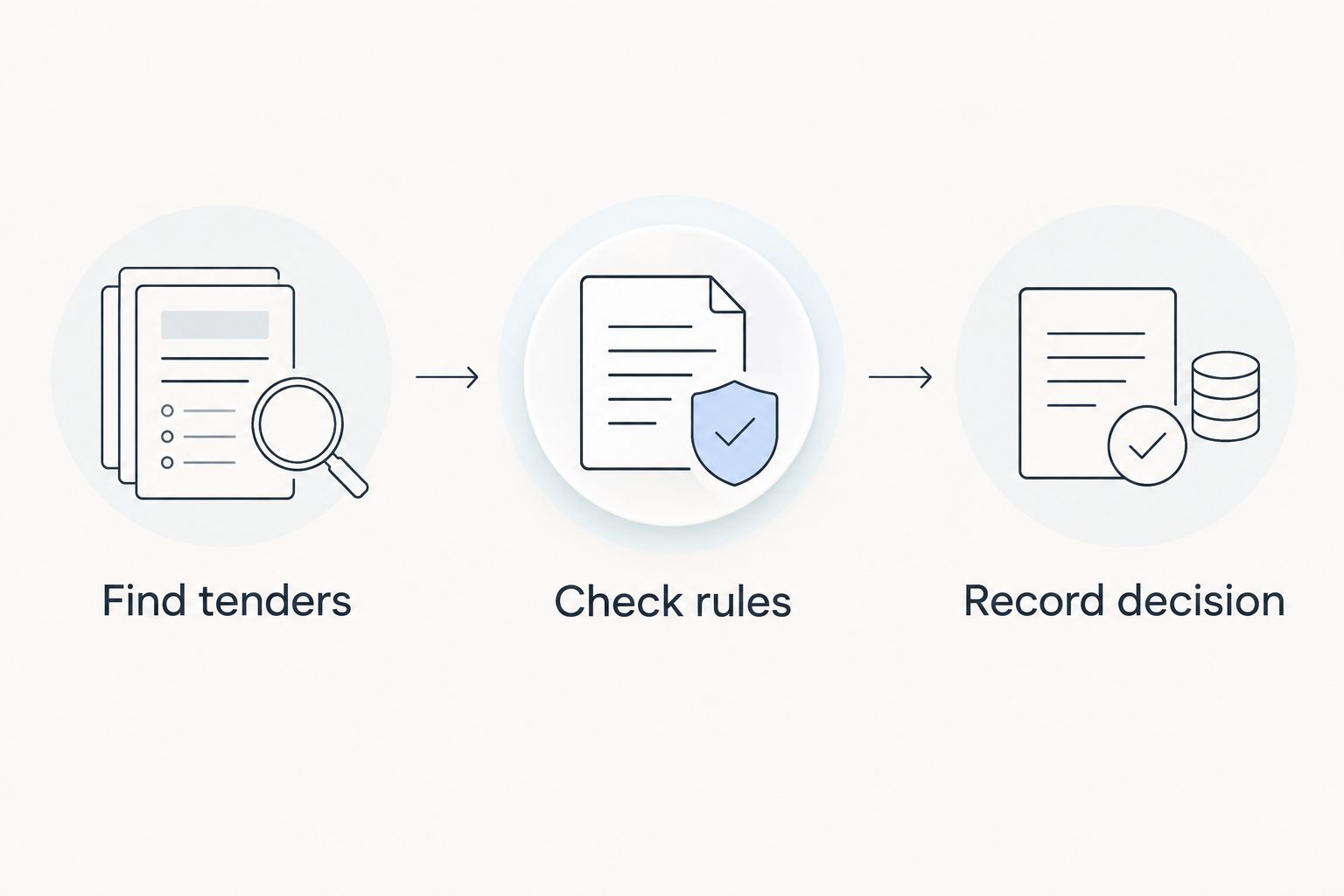
Keep 1 decision record that connects both workflows. Include the opportunity, the material requirement, the source used, the responsible reviewer, and the unresolved question if work cannot yet proceed.
This does not require pretending that either platform provides a particular approval feature. It is a working method your team can apply alongside its research tools.
The honest tie: neither platform turns research into a guaranteed compliant submission. Assign responsibility for the final decision instead of leaving it implicit.
Pricing: compare access models against the work you need
For your 2026 purchase, assess pricing models through their current commercial terms. Do not assume that tender intelligence and legal-reference access are packaged identically.
For tender research, evaluate the access needed to investigate opportunities, contractor information, and bidding results. For legal research, evaluate the access needed to retrieve and use the relevant legal material. Confirm user permissions and permitted use before committing.
The trade-off is predictability versus flexibility. A fixed-scope arrangement makes the access commitment clearer; a variable-scope arrangement requires closer attention to the activity that changes the commitment. Establish which structure each proposal actually uses.
Ask both providers to explain:
- What the proposed access includes and excludes.
- Which users can use it.
- What happens when your research needs change.
- Which terms govern renewal, termination, and use of retrieved material.
Compare the same working requirement, not just the plan label. An access arrangement that excludes a necessary research task is not an adequate substitute for one that covers it.
Final verdict: choose by the question your team owns
Choose Dauthau if you own the opportunity pipeline
Best for: business-development and bidding teams researching Vietnamese procurement. Choose the tender-intelligence platform when your recurring work involves finding tenders, tracking opportunities, examining contractors, and analyzing bidding results.
Its boundary is legal interpretation. Keep a separate method for checking applicable requirements rather than treating procurement intelligence as legal approval.
Choose Thuvienphapluat.vn if you own the legal-reference question
Best for: legal, compliance, and procurement staff researching Vietnamese rules. Choose the legal-reference route when your deliverable is an explanation of the relevant provision and its application to the procurement question.
Its boundary in this comparison is opportunity intelligence. Researching the rules is not the same as maintaining a commercially useful tender pipeline.
One-glance scorecard
| Dimension | Winner |
|---|---|
| Tender discovery | Tender-intelligence platform |
| Opportunity tracking | Tender-intelligence platform |
| Contractor and bidding-results research | Tender-intelligence platform |
| Vietnamese legal research | Thuvienphapluat.vn |
| Starting point for legal interpretation | Thuvienphapluat.vn |
| Source verification | Tie: your team must verify |
| Final compliance responsibility | Tie: your team owns the decision |
| Pricing-model fit | Match current terms to the required work |
FAQ
Is dauthau.asia better than thuvienphapluat.vn?
Dauthau is the better fit for tender intelligence; Thuvienphapluat.vn is the better fit for Vietnamese legal research. Choose according to whether you need procurement opportunities and results or the legal provisions governing your task.
Which platform should I use to find tenders in Vietnam?
Choose the tender-intelligence platform for finding procurement opportunities. Its stated scope includes searching, tracking, and analyzing public and private tenders across Vietnam.
Which platform is better for researching procurement law?
Thuvienphapluat.vn is the better starting point for Vietnamese legal-reference research. Check the underlying text and its applicability before using it to support a procurement decision.
Can I use both platforms in the same bidding process?
Yes, the research tasks are complementary. Use tender intelligence to investigate the opportunity and legal reference to examine the relevant rules, then connect both findings in your decision record.
Does tender intelligence replace legal advice?
No, tender intelligence does not replace legal advice. Opportunity, contractor, and bidding-results research serves a different purpose from interpreting legal requirements for a specific situation.
How should I compare the pricing models?
Compare current access terms against the same defined research task. Check included content, user permissions, permitted use, renewal terms, and how changes in scope affect the arrangement.
Does either platform guarantee a compliant bid?
Do not treat either platform as a compliance guarantee. Your team must verify the applicable requirements and take responsibility for the final submission decision.
One last thing
Before choosing a research platform in 2026, ask the person making the bid decision to review a completed research handoff. If that person cannot trace the recommendation back to the opportunity and the applicable requirement, fix the handoff before expanding access.
Dauthau supports the procurement-intelligence side of that handoff. The useful outcome is not a longer collection of records; it is a decision whose evidence your team can explain.