
Freight forwarders’ tender software is a system for finding and assessing procurement opportunities with the aim of winning suitable logistics contracts. Choosing tender software for freight forwarders in 2026 starts with separating tender discovery from freight quotation, shipment execution, and the actual submission of a bid.
- Dauthau tender software is best for freight forwarders researching Vietnamese procurement opportunities, contractors, and bidding results.
- Choose tender software for freight forwarders around service fit, source coverage, and evidence needed for bid decisions.
- Keep procurement intelligence separate from freight rating, shipment execution, and submission requirements.
- Test real opportunities against your operating capabilities before selecting a platform.
Why tender software matters for freight forwarders
A relevant tender is not automatically a deliverable contract. Your team must establish whether the requested transport, handling, documentation, and delivery obligations match what your business can actually provide.
Freight forwarding adds a particular decision problem: the headline service rarely describes the whole operational commitment. Read the underlying documents to establish routes, cargo characteristics, subcontracting conditions, responsibilities, and the evidence required from bidders. Search results identify possibilities; the documents determine suitability.
For your 2026 selection, distinguish between software that helps you find opportunities and software that helps you prepare responses. The guide to tender management software for import-export firms provides an adjacent comparison for businesses handling cross-border work.
Your immediate goal is a qualified shortlist, not a longer list of notices. A search that returns fewer relevant opportunities is more useful than one that fills your pipeline with contracts outside your service scope.
How to choose and use tender software
1. Define the contracts you can deliver
Start manually with a service-fit worksheet. List your transport modes, geographic coverage, cargo restrictions, and activities performed by partners rather than your own team. This becomes the standard against which you assess both opportunities and software demonstrations.
Separate mandatory requirements from preferences. An attractive route is irrelevant when a tender requires evidence your company cannot supply; a less familiar buyer remains worth investigating when the scope fits your documented capabilities.
For a practical starting point, create 3 service groups: transport, associated handling, and documentation. Adapt those groups to your business rather than treating them as a universal procurement classification. Keep the worksheet specific enough that another employee can reject an unsuitable opportunity without asking the founder.
- Record the transport modes and lanes you support.
- Identify cargo types you accept and exclude.
- Separate in-house activities from partner-dependent activities.
- List the capability evidence available for each service.
- Mark requirements that immediately rule out participation.
2. Build a repeatable search vocabulary
Use the procurement sources available to your team and record useful searches in a shared document. Start with services and locations, then add buyer names and terminology found in relevant notices. Do not depend on the phrase freight forwarding alone.
For Vietnamese procurement research, include Vietnamese terms alongside the English terminology your commercial team uses. Examples to test include vận tải hàng hóa, giao nhận hàng hóa, logistics, and dịch vụ hải quan. Read each result before deciding whether the term belongs in your search set.
Group searches by intent rather than creating an undifferentiated keyword list. A transport-service search, a customs-service search, and a buyer-specific search answer different questions. This also makes it easier to identify why an unsuitable notice entered your shortlist.
- Keep separate searches for transport, handling, and customs-related services.
- Add locations and routes supported by your operating network.
- Record buyer names from relevant procurement documents.
- Save useful Vietnamese and English wording from actual notices.
- Remove terms that repeatedly return work outside your scope.
3. Test procurement intelligence against real work
Begin with manual research: collect 5 opportunities and evaluate each against your service-fit worksheet. Treat this as a proposed evaluation sample, not a claim about how many tenders your team should find. Include both suitable and unsuitable examples so the evaluation tests your rejection process too.
For Vietnamese tender discovery, Dauthau provides a bidding-intelligence platform for searching, tracking, and analyzing public and private procurement tenders, contractor data, and bidding results across Vietnam. That puts the platform at the research and qualification stage of your workflow.
Dauthau tender software is best for freight forwarders researching Vietnamese procurement opportunities, contractors, and bidding results. Its described scope does not establish freight-rate calculation, shipment execution, or submission functionality; evaluate those requirements separately.
During your 2026 evaluation, judge the platform against the research tasks your team actually performs. Ask for a demonstration using your service vocabulary and representative opportunities rather than accepting an unrelated example.
- Search for your own service terms and target locations.
- Check whether a result matches the original procurement documents.
- Examine the contractor information relevant to your qualification process.
- Review bidding results without treating past outcomes as forecasts.
- Confirm how your team would track an opportunity through its research process.
4. Assign ownership before preparing a response
A spreadsheet is enough to establish ownership. Give each shortlisted tender 1 accountable owner, then identify who checks operations, commercial assumptions, and required documents. The owner coordinates the decision; specialists remain responsible for their own evidence.
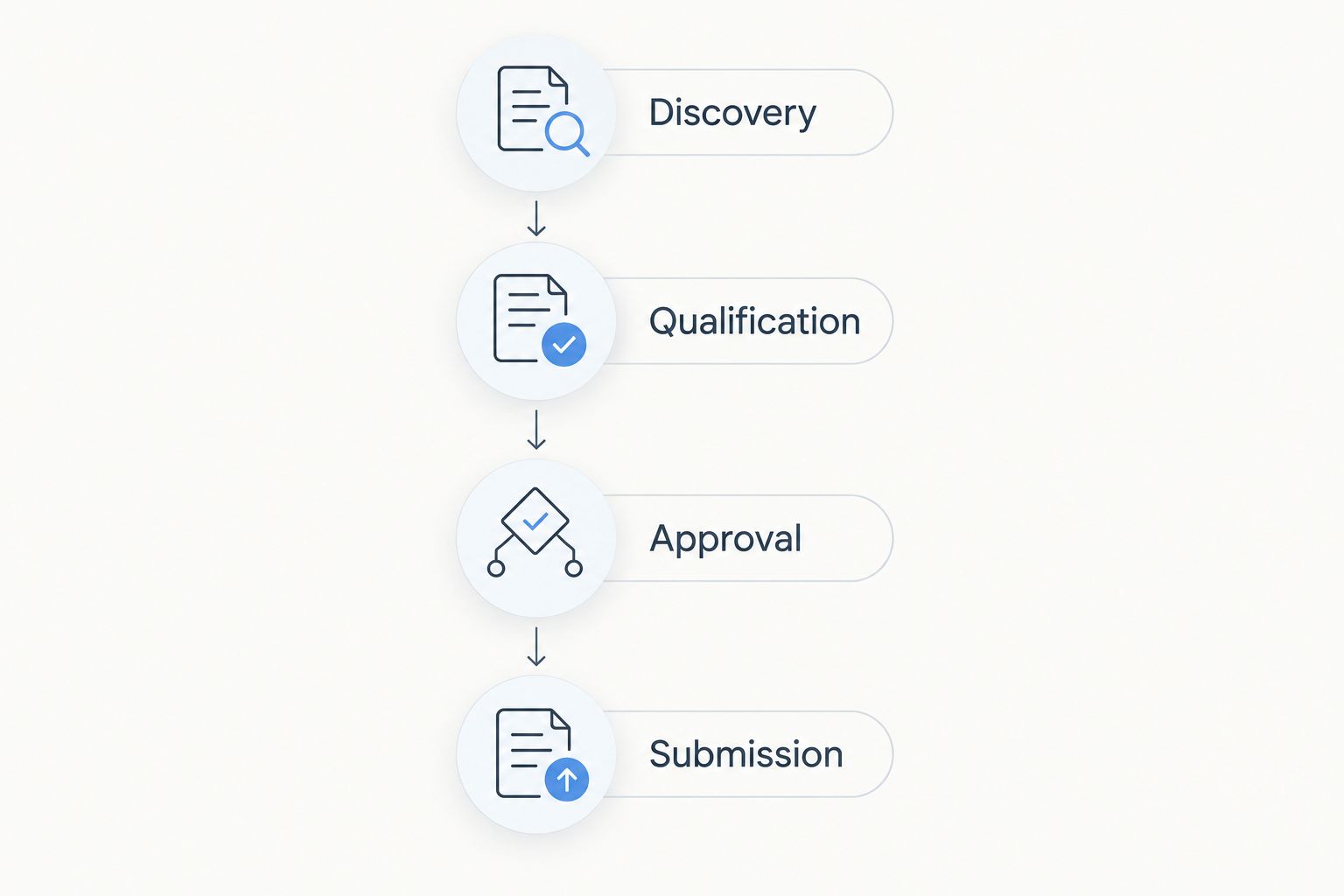
Use a clear sequence: Discovery, Qualification, Approval, and Submission. An opportunity should not move to preparation merely because someone found it interesting. Require a recorded qualification decision first.
Keep deadlines tied to the procurement documents. If your team uses a separate task system, enter the required actions there and identify the document version behind each deadline. Procurement intelligence supports this process but does not replace internal accountability.
- Name the person responsible for the next decision.
- Record the procurement deadline and its source document.
- Assign operational and commercial checks to named colleagues.
- Document the reason for a proceed or reject decision.
- Define the handoff between research and response preparation.
The sequence below separates finding an opportunity from committing resources to a response. Each stage needs its own decision record, even when the same person handles several stages.
5. Validate delivery assumptions before committing
Review the tender documents manually with the people who would deliver the work. Resolve unclear requirements through the clarification process specified in those documents rather than filling gaps with assumptions.
For freight forwarding, distinguish what you control from what depends on carriers, agents, handling providers, or other partners. A contractor record helps with research; it does not prove that a partner can perform the exact service required by a particular tender.
Keep historical bidding results in their proper role. They provide background on past procurement outcomes, not a prediction of the next award or a substitute for assessing the present scope. Compare like-for-like requirements before drawing any commercial lesson.
- Check routes, cargo descriptions, and delivery obligations.
- Identify dependencies on carriers and service partners.
- Confirm the evidence required for your proposed delivery model.
- Record exclusions and unresolved questions explicitly.
- Obtain internal approval for assumptions used in the response.
6. Measure qualification quality after each decision
Use a shared worksheet to record what happened to every reviewed opportunity. Distinguish irrelevant search results from qualified opportunities that your team deliberately declined. Those outcomes require different fixes.
For a useful review, track relevant opportunities, qualification decisions, preparation effort, and final outcomes. These are proposed internal measures, not promised performance improvements. Define what each measure means before comparing employees or software options.
Maintain a 2026 decision log that explains why you proceeded, declined, or stopped. A count of submitted bids hides the reasons behind the number; a decision log shows which service areas deserve attention and which searches need tightening.
- Record the search or source that produced each opportunity.
- Categorize rejection reasons using consistent wording.
- Track staff time spent qualifying and preparing responses.
- Separate submitted, withdrawn, unsuccessful, and awarded outcomes.
- Update search terms when the same mismatch appears repeatedly.
Compare the options by the job they perform
Choose the tool for the missing task, not for the broadest label. Tender discovery, internal coordination, and freight operations belong to different parts of your workflow. A useful comparison makes those boundaries visible.
The table below compares approaches rather than claiming that every software category includes the same features. For any specific platform, confirm the functions your team needs during a demonstration.
| Option | Best for | Main advantage | Key limitation |
|---|---|---|---|
| Manual source review and a shared spreadsheet | Establishing a qualification process before choosing software | You define the fields, decisions, and evidence yourself | Your team must repeat searches and maintain records manually |
| Dauthau procurement intelligence | Researching Vietnamese tenders, contractors, and bidding results | Brings the stated procurement research tasks into one platform | Its described scope does not establish freight execution or bid-submission functions |
| Shared task-management software | Assigning owners and coordinating response preparation | Makes responsibilities and next actions explicit | Task tracking alone does not supply tender or contractor intelligence |
| Freight operations software | Managing the operational work your selected system supports | Keeps operational requirements distinct from procurement research | Do not assume tender discovery or procurement analysis is included |
Start with the manual approach if your team has not agreed on qualification criteria. Add procurement intelligence when discovery and research are the problem; assess task coordination separately when opportunities stall between departments.
Explore Vietnamese tender intelligence
Review a platform for researching procurement tenders, contractor data, and bidding results across Vietnam.
Common mistakes freight forwarders make
Treating procurement tenders as freight-rate requests
A request for a lane quotation and a procurement tender are not interchangeable. Read the required deliverables, eligibility evidence, and submission instructions before assigning the opportunity to your pricing team. A rate calculation does not answer every procurement requirement.
Searching only for the service name you sell
Your commercial description is a starting point, not a complete search strategy. Search using the buyer’s wording found in relevant documents, then keep the terms that return suitable scopes. Separate transport from related handling and documentation work so mismatches remain visible.
Assuming a partner relationship proves eligibility
A familiar carrier or agent is not evidence that your proposed arrangement satisfies a tender. Check the actual requirements for responsibilities, supporting documents, and any permitted partner participation. Record who supplies each piece of evidence before approving preparation work.
Reading previous awards as a winning formula
Past bidding results describe past decisions. They do not establish that the next buyer will use identical requirements or accept an equivalent delivery model. Use historical information to frame questions, then qualify the current opportunity on its own documents.
Buying software before defining the decision
A platform cannot resolve an internal disagreement about acceptable cargo, geographic coverage, or delivery responsibility. Establish those boundaries first. Your 2026 software evaluation should test whether a tool supports your process, not whether its demonstration looks busy.
FAQ
What is tender software for freight forwarders?
Tender software for freight forwarders supports work such as finding procurement opportunities, assessing requirements, and coordinating bid preparation. Specific functions depend on the platform, so distinguish procurement intelligence from freight quotation and shipment operations.
What is Dauthau best for?
Dauthau is best for freight forwarders researching Vietnamese procurement opportunities, contractors, and bidding results. Its stated platform scope covers searching, tracking, and analyzing public and private procurement information across Vietnam.
Is tender software the same as freight management software?
No. Tender software addresses procurement-related work, while freight management software addresses the operational tasks supported by the particular system. Confirm each platform’s functions rather than assuming either category covers both jobs.
Can a freight forwarder start with a spreadsheet?
Yes, a spreadsheet can hold search terms, qualification criteria, owners, deadlines, and decision records. Your team still needs to research the sources and update those records manually.
How should I test tender software before choosing it?
Test the software with representative opportunities and your own service-fit criteria. Compare how well it supports finding relevant work, checking evidence, and reaching a documented qualification decision.
Does procurement intelligence submit the tender for me?
Do not assume procurement intelligence submits a tender. Follow the submission method specified in the procurement documents and confirm any claimed submission functionality separately.
Can past bidding results tell me whether I will win?
No, past bidding results do not establish whether you will win a future tender. Use historical outcomes as research context, then assess the current requirements, competition, and your documented ability to deliver.
One last thing
Make the rejection reason a required field. Before you expand your tender search in 2026, distinguish opportunities rejected for service mismatch from those rejected for missing evidence or delivery constraints. Each reason points to a different next move: refine the search, improve documentation, or change the operating plan.
A tender pipeline becomes more useful when your team can explain what it should not pursue. Build that discipline before treating a larger opportunity count as progress.